

She Never Gave Up on Me
By: Conner Drigotas
In the 1960’s, an era when dyslexia had no name and little understanding, teachers saw young Douglas Franks as a boy who didn't fit. "It was, I was retarded, you know, something wrong with me," he says plainly.
It made him appreciate the one person who never saw him that way, even more.
His mother, Ernestine Franks, he says was “a force of nature.” And when her son struggled, she fought for him. "My mom never gave up on me," Douglas says, "and when she needed me, there was no way in hell I was not going to fight tooth and nail for her."
That fight would consume four and a half years of his life, cost him money and uncountable hours of sleep, and introduce him to a system he describes as corrupt from top to bottom: state controlled elder guardianship.
Best Laid Plans
In 2011, Ernestine walked into her attorney's office and made her wishes clear. She wanted Douglas to hold her power of attorney, serve as her healthcare surrogate, and act as her guardian should she ever need one. "All the ducks were in a row," Douglas says. She had a trust to handle her finances, and she had her son. She had planned carefully.
It wasn’t enough, however, to prevent state officials from taking control. Douglas alleges that while attempting to change trust administration companies, a trust company manager at risk of losing business told Douglas’s brother he needed to file for guardianship to protect his own interests, effectively freezing Ernestine’s assets. Once invited in, state officials took swift action.
Despite Ernestine’s established plan for Douglas to provide her care, a Florida judge ruled that state guardianship and oversight of daily care could proceed. Douglas was stripped of the power of attorney and healthcare surrogate status.
"All of my mother's advanced directives were evaporated," he says. "It's very clear she has a trust, so that takes care of her bills. She has me, as her power of attorney, healthcare surrogate, and the guardian. All the ducks are in the row and the judge said, ‘well, I think we need to go ahead anyway.’"
He pauses. "This silver bullet that my attorney had is a blank."
"It's time for you to leave"
With his mother placed under guardianship, Douglas's access to Ernestine became a managed, metered, supervised transaction.
Every visit required pre-approval. Every hour had a price. State-appointed supervisors sat in the room, watching, listening and making sure nothing was said that could be characterized as upsetting to Ernestine.
After the guardianship was established, Douglas drove Ernestine to her home in Florida and stayed for a few days. Then the call came. "The guardians said, 'You, Doug, you've been there long enough, it's time for you to leave…’ The house I lived in since I was three years old. It's time for you to leave, and I just couldn't believe it. They said, ‘we'll let you know when you can come back.’"
He drove back to Atlanta. "I cried the entire way," he says, "because I just thought, what's happened? How did I fail this woman that never failed me? I messed up. What could I have done differently?"
Douglas says months passed before guardians allowed him to return, and then only on pre-approved days and hours. Supervisors informed him their time together would require a paid chaperone costing $100 an hour. When Douglas said he couldn't afford that, the response was breezy: Ernestine’s trust would cover it.
Ernestine's own money, meant to provide for her care and comfort, was being used to pay strangers to watch her son visit her.
Douglas says he was walking on eggshells during visits, having to consider government supervisors’ perceptions alongside his mother’s best interests. A mistake could cost him dearly: "They even said: 'if you upset your mom, we're going to have to put her on medication, and we can also restrict you.'"
Douglas, wary of a guardianship industry that is known to be full of corruption, started bringing a video camera to every visit. "There was no way that someone's going to say ‘Doug upset his mom.’"
Some weekends, he was there for two days. A long weekend might cost $900. He made the most of every hour: seafood for lunch, scratch-off lottery tickets spread across the kitchen table, birdhouses they built and painted together. "When I left, I was exhausted," he says. "Even when I went there for three hours a day, it was like a week's worth of interaction. It was nonstop."


But the clock was always there. In one instance, Ernestine was in the middle of being seen by a doctor when the supervisor interrupted: "Doug, your time's up, time for you to go."
This lack of compassion is the natural end result of coercive systems. Checking the box of what’s right by the letter of the law becomes more important than compassion for a human being.
Douglas couldn't tell his mother the truth about why he kept leaving. She would ask him to spend the night, and he would make something up. "I didn't like lying to my mom,” he recalled quietly. “But if I told the truth, then I'd never get to see her."
One fear lived above all others during those years. "What if mom dies and I'm forced to leave?" he asked. "That is the most hurtful thing that's ever happened to me in my life, to have to walk away from someone that I love that could be dead an hour or a day after I leave."
He never quit. "There is too much money in this" was his observation of the process, but Douglas Franks kept the faith. "I always had a hope in my soul," he says, "and I want to tell you how big it was. It was the size of a pinhole, but I never gave up."
Forty-Five Days
In the end, Douglas won his mother’s freedom. When “the cash dried up,” $2 million drained from Ernestine over the course of the ordeal, Douglas says “the guardianship company gave up.” Ernestine was set free, provision of care was put back under Douglas’s control, and Douglas says she came alive. "After I won her freedom, man, she was kicking ass. My mom was at a higher mental state than she'd ever been."
After four and a half years of fighting, Douglas and his mother got just forty-five days of freedom on the other side. While out on an ice cream date with her son, Ernestine Franks suffered an episode and passed away at 94 years old.
"The good spin is: ‘guess what, Doug, you didn't get your mom back in a box, you got her back, you had great times together.’ We did a lot of stuff in 45 days, a hell of a lot of stuff."
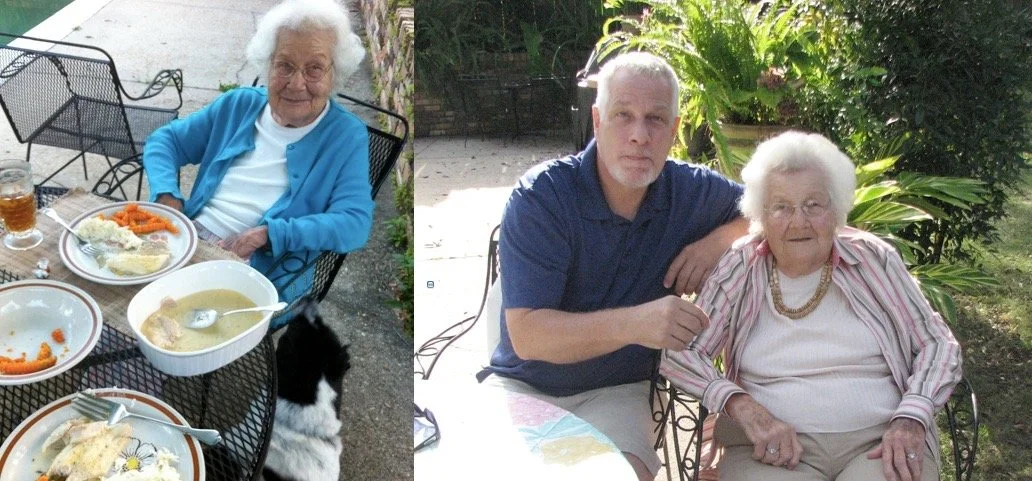
When Douglas looks back on what was done to his mother and to their family, he does not reach for forgiveness where he doesn't feel it. "These attorneys, these judges that hurt these people; elder abuse, child abuse. Those people, I don't have forgiveness for them. They hurt people who couldn't defend themselves. When you selectively manipulate someone who cannot defend themselves, that's low."
He believes accountability is missing across the guardianship system. "If there was a financial penalty and jail time, they would stop tomorrow. They need to lose their license. They need to be put in jail for what they did."
Ernestine, Douglas says, was "A mini stimulus package for Escambia County, Pensacola, Florida. Why wait for this woman and her sons to get old? Let's break this bank now. It's easy… and it was very easy."
As guardianship continues to grow as a problem nationally, accountability is hard to find. There are few stories like Douglas’s, where there is even a small window of peace. "I think someone smarter would have quit, would have walked away,” he says, “but I can't walk away. I got to fight."
Douglas says his mother made him that way. She dedicated so much to helping her son overcome challenges and modeled the heart of a fighter that he carries forward to this day. "This lady helped me and never gave up on me," he says. "And I never gave up on her."