Built to Last
By: Conner Drigotas
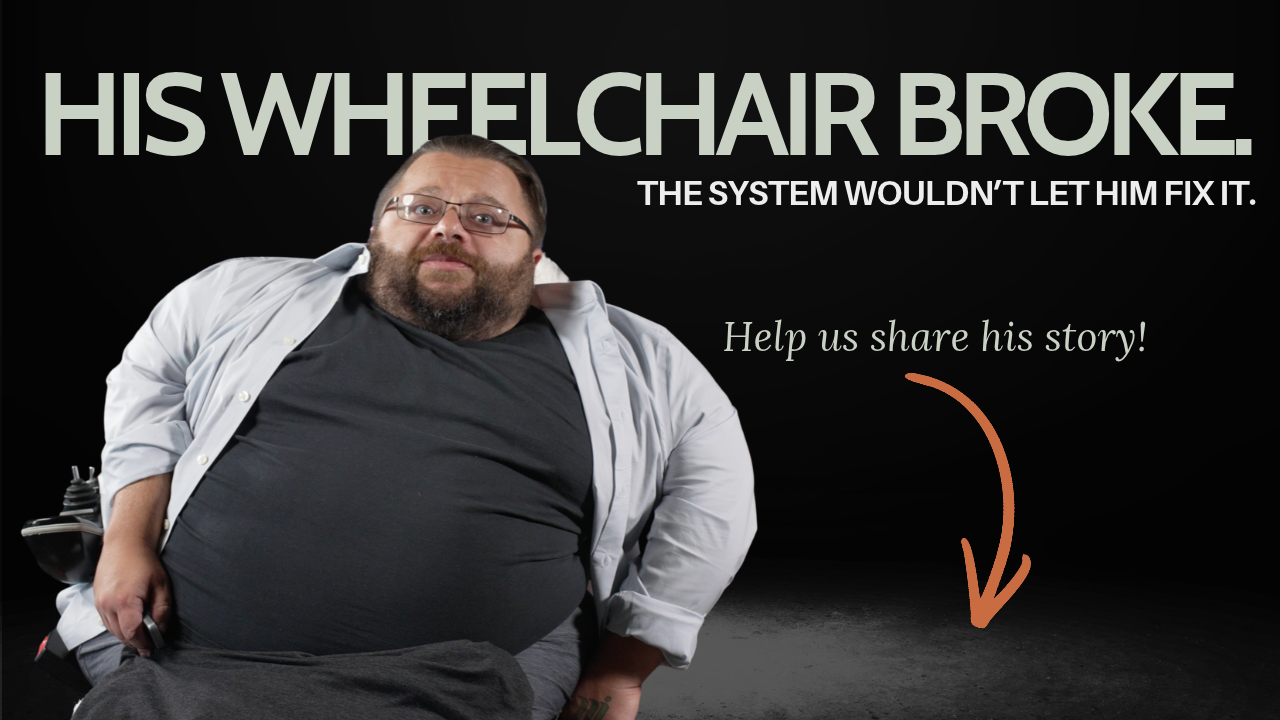
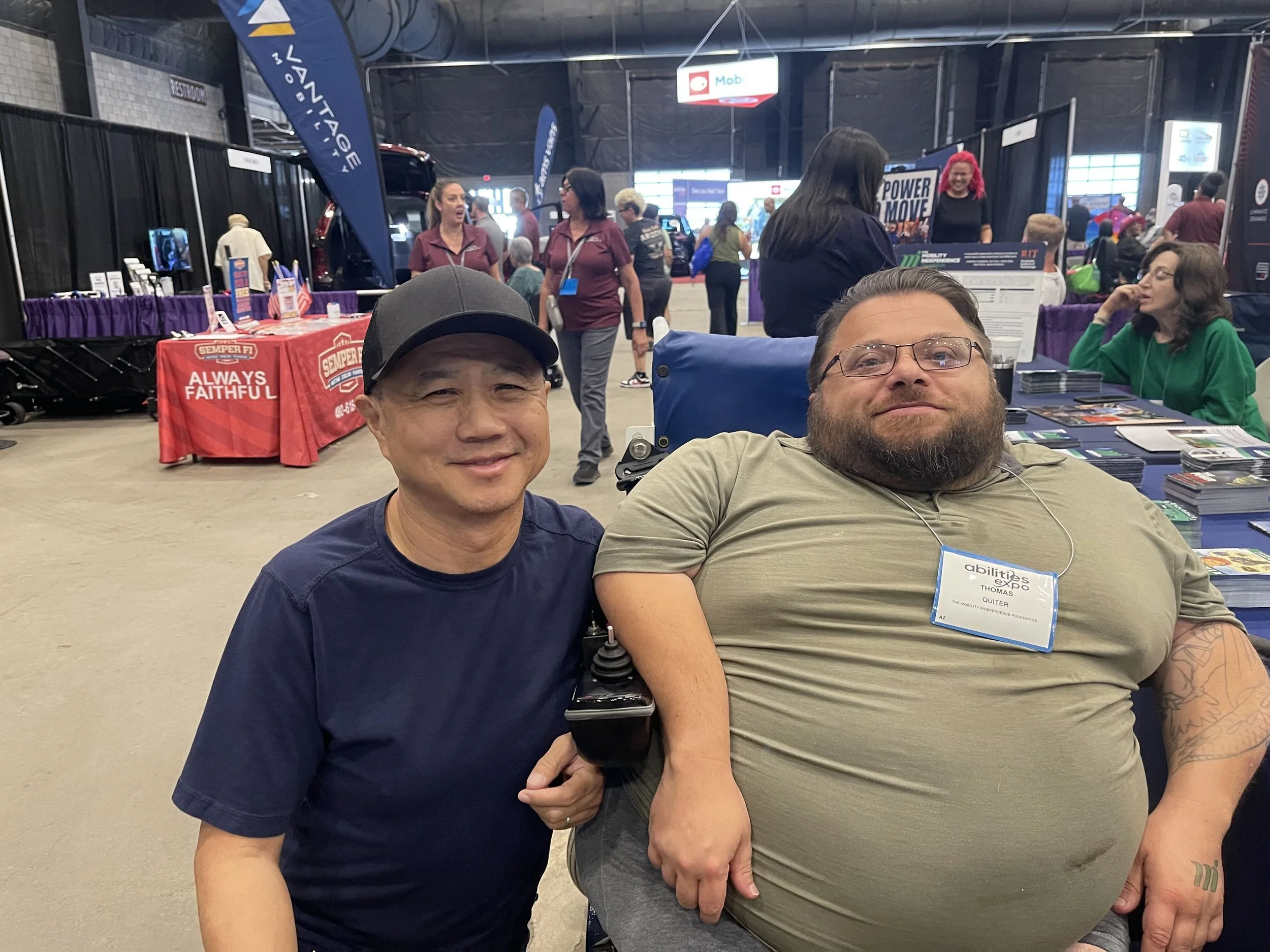
Thomas Quiter was born with osteogenesis imperfecta, a condition also known as “brittle bone disease.” He has broken his bones more than a thousand times in his 42 years, and relies on a power wheelchair to move independently and pursue his best life.
This self described “farm boy, kind of sheltered from the start,” has been pushing for a better world for his entire life. He describes his upstate New York hometown as “impoverished, everybody had their problems,” but as a place where “good family and friends made it work. Whatever had to be done.” His challenges have made him a fighter, and there is significant work ahead.
For the past 27 years, he has been an advocate for human flourishing through a variety of causes. The last four years, however, have been dedicated to a mission that hits close to home: creating an alternative to the government protected stranglehold on power wheelchairs.
“My disability isn’t what limits me most,” Quiter says, “It’s being coerced into using equipment that wasn’t built for me. I can’t repair it when it breaks, and I had little say in choosing it.”
The Medicaid Mess
Since the start of Medicaid in 1965, wheelchairs have been included in the program’s “durable medical equipment” (DME) benefit. Power wheelchairs were added to the program throughout the 1980’s and 1990’s as new technology emerged. Advanced models in 2026 can help people with severe physical or neurological conditions, like advanced ALS or cerebral palsy, become independently mobile through sip-and-puff controls, eye-gaze tracking systems, and built in life-support systems.
In some ways, it’s a golden age. The mobility technology advancements have been life changing for many, Quiter says. Unfortunately, it’s also an era of uncompetitive market tactics and dead ends. Government officials have made deals with power wheelchair manufacturers that shortchange the end user in a variety of ways.
When a power wheelchair breaks, the contractual agreement limits who can legally fix it. Manufacturers lean on patent law exclusive Medicaid agreements to limit choice, and the result is repair waitlists that can stretch for more than a year. A broken chair often means the user is trapped at home. Quiter experienced this firsthand. He says he was at one point effectively bedridden for five years. Many wheelchair users, he says, become shut-ins or end up in institutions, because the problem is being artificially created through a distribution and service monopoly. Currently, two national conglomerates, Numotion and National Seating and Mobility (NSM), control more than half of the United States complex rehabilitation market and in some states and smaller insurance networks, they are the only approved suppliers.
The cozy relationship between government officials and power wheelchair providers, Quiter says, is also driven by unnecessary greed.
Top end specialized power chairs can cost $80,000 to $100,000, and Quiter says the manufacturers can drive more revenue by controlling licenses and repair parts, an arrangement backed by the force of law.
“You do not own your wheelchair,” Quiter says, “but you are expected to pretend to be happy about it.” Because the contracts come attached to Medicare and Medicaid, people who depend on them have no other contract to turn to. As Quiter sees it, the choice is to rely on disability benefits or be independently wealthy, with nothing in between. “That’s human life on taxpayer dime,” he explains.
Medicaid officials pay lip service to the idea of helping people and, indeed, the erosion of community institutions means that many feel government is the only way to get what they need. The centralized cure is, for many, however, turning out to be worse than the disease.
The Principle of Human Respect recognizes that diminishing wealth by force reduces happiness, harmony, and prosperity. Medicaid’s one-size-fits-all approach is funded by taking money from people without their consent through taxes, and offers a low-quality experience that doesn’t align with Medicaid’s stated purpose to “provide an important foundation for maintaining the health of our nation.”
So, there is an opportunity for something new.
Quiter’s Mobility Independence Foundation (MIF), alongside a growing coalition of students, engineers, and advocates across the world are building an alternative set of power wheelchair options, hoping to give more people the freedom to move and, along the way, dethrone those who have grown rich at the expense of the disabled.
An open-source future
Thomas Quiter founded the Mobility Independence Foundation in 2022 to build that new option. His nonprofit works with college engineering programs to design open-source mobility equipment that is “so durable, adaptable, and simple that a high school shop class could make or repair one.”
The lineup already has names. The Endurance is MIF’s flagship adult mobility platform, with personalized builds currently in the works, the RozRover is a pediatric mobility initiative, and the Explorer is a modular platform the organization is currently exploring. Quiter says the Endurance is designed to last 30 years and is an especially important product. Half of all wheelchairs, he says, end up in the dump in three to five years.
Each of the Foundation’s products is a step up from what is currently being offered through Medicaid. The electronic components inside many commercial power wheelchairs date to the 1970s, and Quiter says he has met 11-year-olds doing hobby robotics more advanced than the machines offered through Medicaid. “The goal here is to create a competing ecosystem, and then once the old one just kind of fades out, why do we need it?”
Quiter’s alternative maximizes choice, focuses on what’s best for the end user, and doesn’t require force or coercion to help people. “Back when I started, everybody was making the argument for a bigger cage,” he says. “Today, everybody’s making the argument for an exit.”
Ultimately, Quiter knows it is possible to do good while doing well, and pushes back on the idea that government officials get some special pass to do harm when they work to “fix” mobility problems. “What’s wrong for individuals to do to each other remains wrong when corporations do it through patent restrictions or when governments enforce those restrictions,” he says, “Restricting someone’s ability to repair their own property is coercion, and it is wrong whether or not anyone intends harm.”
Quiter and his allies are rolling forward with the same determination he was raised with: doing “whatever has to be done”. He runs MIF remotely, says he puts in 80 to 120 hours of work per week, and isn’t yet paid for any of it. Though the Mobility Independence Foundation has raised over $250,000 since launching, Quiter is quick to say they have a ways to go. “I break bones on the road. I don’t get compensated. We need money.”
To support the Mobility Independence Foundation and help put a durable, repairable wheelchair within reach of anyone who needs one, donations can be made via the foundation’s website. https://themif.org/action/donate/