
A “Completely rogue” attack decimates baby sleepwear company
By: Conner Drigotas
Necessity is the mother of invention, and mothers know better than almost anyone else the value of a good night’s sleep for them and their young children. That was why, after the birth of her second child, Manasi Gangan was anxious to find a solution to her suddenly short supply of restful hours.
“During my second maternity leave, my second son wouldn’t sleep. And the engineer in me was wondering, how come he sleeps only in my arms? What does he receive? So, I started improvising.” Manasi told Respect America in an interview, “I had reached a point where I was looking for a more purposeful way of contributing.” Manasi, an engineer with over a decade of experience in technology and consumer product development, set out to find a solution to her sleepless nights.
Manasi was inspired by neonatal units using improvised positional aids to mimic human touch, sending a signal to the infant that they are safe and secure. Sometimes that’s a latex glove filled with rice, beads, or water rested on an infant and, in other cases, there are medical devices that do much the same thing. And, she was encouraged by a neonatal research study showing the soothing effects of simulated parental touch.
“And that gave the idea of creating a garment, creating a sleepwear that would mimic a parent's touch.” Manasi says, “And that's what [our company] Nested Bean is. We started with a flagship product of a swaddle, and then evolved into a line of sleepwear that goes all the way into the second year.”
But before a single item was manufactured, Manasi spent over a year and half carefully designing and developing her product. Manasi undertook extensive voluntary safety testing prior to launch. Following international standards for consumer products and the Consumer Product Safety Commission (CPSC) recommendations for best practices, Manasi sought to have her product designed and manufactured as safely as possible. She shared her early designs and prototypes with safety labs and human factor design experts to evaluate the safety of Nested Bean products. She sought advice from sleep safety experts and safety labs throughout the design, development, and production phases. All of these voluntary steps were to ensure safety and quality, taken at Manasi’s expense, before making her first dollar.
Between 2011 and 2024, Manasi’s company, Nested Bean, became an international brand. Featured in big box stores, local kids’ boutiques, and commonly featured in mom groups on social media, the company grew from one small idea into tens of millions in revenue, selling over 2.5 million units.
“There were many, many steps of validation before we went online with it and started distributing it to retailers. So, [after] years of multiple validations… we don't have a single complaint that has attributed any harm to our product.” After millions of products sold, Nested Bean has maintained a stellar safety record with no deaths or injuries attributed to its product.
Today, Manasi’s Nested Bean has been decimated – losing 90% of their revenue as a result of “shortcuts” taken by government bureaucrats, a federal commissioner gone “completely rogue,” and a misreading of science by government officials that has yet to be resolved almost three years later.
“They just ruined a company that had been in business for 13 years, almost 15 years, because this has been going on for two and a half years now, without looking at any track record, without bothering to follow process, which is what this whole lawsuit is about. No due process, no documentation, no definition. Just went ahead and put something out there without thinking what impact it’s going to create.”
“An unreasonable risk”
A federal organization called the Consumer Product Safety Commission (CPSC) has the authority to determine whether a consumer product presents an unreasonable risk of injury. Unlike the Food and Drug Administration that requires safety to be proven before a product goes to market, consumer products do not require proof of safety. Instead, consumer products are generally regulated by the CPSC after an unreasonable risk of injury has been identified. The CPSC has the authority to determine mandatory safety standards, issue a recall, or product ban for consumer products, and exercises that power by creating an administrative rule. But before the CPSC can create an administrative rule it must first identify the degree and nature of risk of injury associated with the product and how the proposed action is reasonably necessary, and is designed, to eliminate or reduce the risk of injury. Typically, this organization is run by five appointed commissioners. These commissioners control everything from deciding if a baby product is safe for use to whether consumers should be allowed to use gas stoves, but the decision to do so must be after a majority of the commission votes in favor of a specific action.
But one former commissioner, Richard Trumka Jr., has a pattern of ignoring the statutory authority of the CPSC, abusing his position of power, and bucking the consensus of the entire commission. In 2022 Commissioner Trumka pushed for greater regulation of gas stoves, but no other commissioner supported it. Despite lacking full commission support, then CPSC commissioner Richard Trumka Jr. led a multimedia campaign stating that the CPSC was working to ban gas stoves. The public backlash was so severe the Chairman of the CPSC had to issue a statement denouncing Trumka’s falsehoods.
Then Trumka Jr. turned his attention to attempting to ban weighted infant sleep products. Manasi’s legal complaint reads that Trumka Jr. “made it his personal mission to destroy the industry of weighted infant sleep products…”
In 2023 Trumka pushed the Commission for greater regulation of weighted infant sleep products, but none of the other commissioners supported the proposal. Despite Trumka Jr’s attempt to create mandatory safety standards for these products, his concerns were rejected by his fellow commissioners in a 3-1 vote, one of whom said that rulemaking “at this time [was] premature” because the CPSC did not have the statutorily required data showing an unreasonable risk of harm or a hazard pattern identified with these products. In fact, the CPSC has not even created a definition for what is considered a “weighted” infant sleep product. To date, the term “weighted” is just an industry term.
Trumka wasn’t satisfied with the Commission’s lack of action, so in early 2024 “Commissioner Trumka wrote letters to major retailers and announced publicly that weighted infant sleep products were dangerous and presented an unreasonable risk to consumers.” He then posted these statements all over his official CPSC social media accounts.
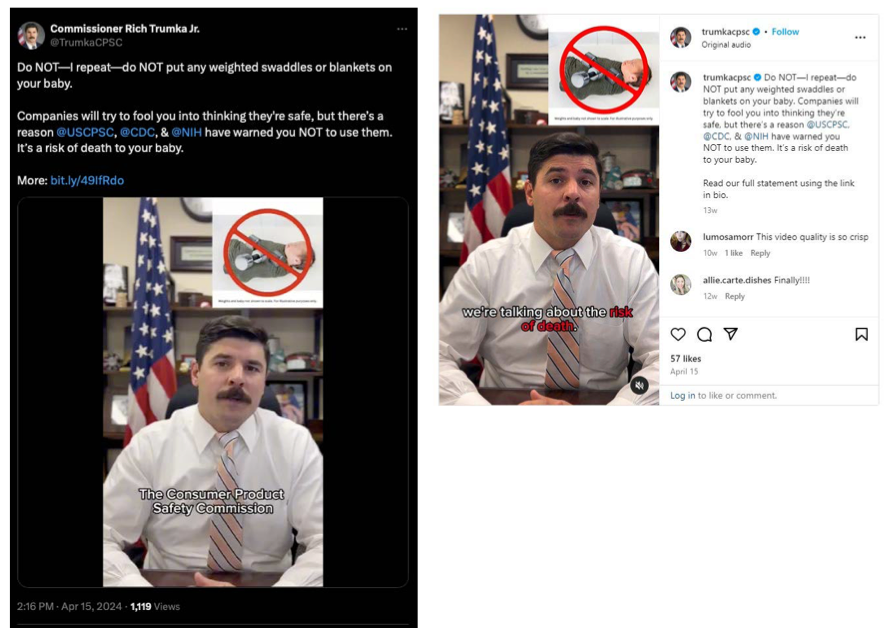
Because Trumka issued these statements on official CPSC letterhead, CPSC website, and CPSC social media accounts, retailers interpreted his statements to be an official decision by the entire Commission banning or recalling weighted infant sleep products. Retailers responded to Trumka’s letters by pulling all of Nested Bean’s products within days, even though the other CPSC commissioners disagreed with those statements.
Trumka’s unlawful action against Nested Bean led to a Congressional investigation into Trumka by the House Committee on Small Business.
When challenged for his damaging words, Trumka Jr attempted to claim, and still maintains, that communications on official letterhead, posted on CPSC social media, and on the CPSC website were merely “personal statements.”
Underlying Trumka Jr’s vendetta against weighted infant sleep products was reliance on what Manasi’s complaint calls “unsupported product safety determinations regarding weighted infant sleep products” from the Centers for Disease Control and Prevention (CDC) and National Institutes of Health (NIH). The CDC and NIH have a joint campaign to educate the public on ways to prevent sudden infant death syndrome (SIDS), titled Safe to Sleep. The Safe to Sleep campaign generally focuses on safe sleep practices based on years of scientific research and findings. Recently the CDC and NIH adopted the American Academy of Pediatrics (AAP) new position advocating against weighted infant sleep products. The AAP’s position was based on a single study, but that one study did not conclude that weighted infant sleep products were dangerous. Instead it found that weighted infant products may be beneficial. In other words; far from showing harm, there was a human error interpreting the underlying study which Trumka weaponized in his role as a CPSC commissioner.
The CDC and NIH do not have the statutory authority to opine on the safety of consumer products. Furthermore, Manasi clarified why a blanket ruling banning all weighted infant sleep products doesn’t make sense: “They took a study that proved no harm, in fact, [showed a] benefit, and they used it to cause concern, without understanding that our product had a very safe route and an adaptation using only one ounce of weight in a very specific area, with millions sold and no incident. So, it felt like just a hack job without really going through any due process, or so much as an investigation.”
“Personal statement” or not, the effect of Trumka Jr’s letters, statements, and social media campaign were felt almost immediately as retail partners pulled out, forcing the layoff of 93% of Nested Bean’s workforce, all with no attempt by CPSC officials to actually verify the product’s safety.
“Our revenue went down by more than 90%. The effect was almost immediate. He sent letters to retailers [using CPSC channels], and within a day or two the major retailers, Amazon, Target, dropped Nested Bean… It's devastating to know that your life's work is being disregarded without so much as a dialogue.”
“unfounded, unsupported caution”
With the help of the nonprofit law firms Pacific Legal Foundation and Liberty Justice Center, Manasi and Nested Bean filed a lawsuit in March 2025 asking for a relatively simple fix:
“It's asking essentially for them to walk back their actions,” says Manasi’s attorney, Loren Seehase, “They took some very public actions that defamed [Manasi and] Nested Bean… And so we were asking the court to recognize that those actions were unlawful and order the government to retract them.”
Manasi also believes her situation puts a spotlight on a big communication problem and wants to see issues proactively addressed when there are safety concerns.
“Don't just throw out warnings and words of unfounded, unsupported caution without giving us the opportunity to prove how these products have been designed to be safe,” she says, “Invite us and let's work towards safety together, because I think we have the same goal.”
Same goal or not, the root problem remains: officials at the CPSC are diminishing wealth by force by taking away Manasi’s ability to provide value to parents who need her product. There is no way for Manasi, or her customers, to opt out of CPSC officials' coercive practices.
When she spoke with Respect America in November 2025, Manasi’s lawsuit was hanging in limbo pending the end of the federal government shutdown. Despite having no way to advance her cause at the time, Manasi was clear about her hopes for the future:
“My overall message is that I really hope that entrepreneurs or the dreamers don't stop creating new value, because that's what I genuinely believe in.”